
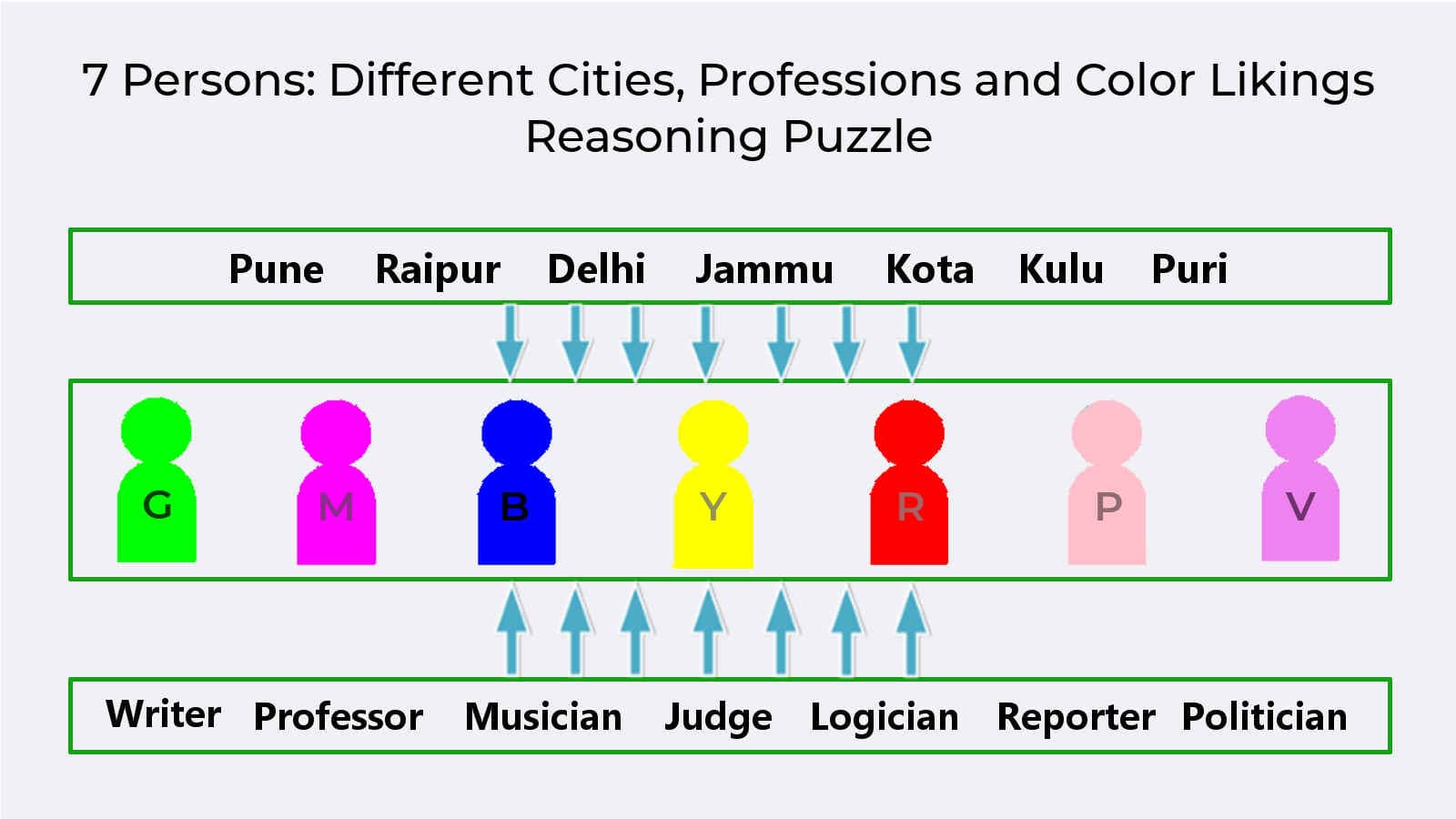
Seven persons each from a different place, have different professions and like different colors. Answer five questions from 12 Clues.
7 Person Three Properties Reasoning Puzzle
Description
There are seven persons Rio, Mani, Chiku, Kuttu, Priya, Anik and Sanju with one of them from Pune. Each of them is from a different place, has a different profession, and likes a different color.
Clues:
- Chiku, a Judge, is from Kota.
- Priya and Anik like Green and Magenta, though not necessarily in that order.
- Rio is not from Kulu.
- The person from Kulu is a Writer and likes Blue.
- The Reporter likes Yellow.
- The Politician from Puri likes Magenta.
- The Professor and the Musician like Violet and Red, though not necessarily in that order.
- Anik is a Logician.
- The person from Raipur is a Professor.
- The person from Delhi likes Red.
- Sanju from Jammu does not like Pink.
- Mani is a Musician.
Questions
Question 1. Who likes color Blue?
- Kuttu
- Anik
- Chiku
- Sanju
- Rio
Question 2. What is the place of the Logician?
- Delhi
- Kota
- Puri
- Jammu
- Pune
Question 3. What is the color that the person from Raipur likes?
- Red
- Violet
- Magenta
- Pink
- Green
Question 4. What is the color that Anik likes?
- Red
- Magenta
- Yellow
- Green
- Pink
Question 5. Which of the following combinations is correct?
- Puri-Red
- Chiku-Kulu
- Judge-Pink
- Delhi-Reporter
- Rio-Musician
Hints:
- Decide which of Person, City, Profession and Color will be the Primary object against which other three will have to be correctly assigned.
- Use the primary object as the header row with seven columns and the other three as the three rows. This will be the design of the assignment table.
- Identify the values of the cities, professions and colors liked by scanning the Clues.
- Identify suitable sequence of Clue analysis to get most assignments at the earliest.
- It is not necessary to take up the Clues in the given order.
Solution to the 7 Person Three Properties Reasoning Puzzle: Preparation
Identification of the objects and their roles
Primary object is the Person as the seven header labels:
- Rio, Mani, Chiku, Kuttu, Priya, Anik, Sanju.
Secondary objects are the three properties forming the row labels. Clues are scanned to get the values:
- City: Pune, Raipur, Delhi, Jammu, Kota, Kulu, Puri.
- Profession: Writer, Professor, Musician, Judge, Logician, Reporter, Politician.
- Color liked: Green, Magenta, Blue, Yellow, Red, Pink, Violet.
Showing the Assignment of a Correct Property Value to a Person at Every Stage of Clue Analysis
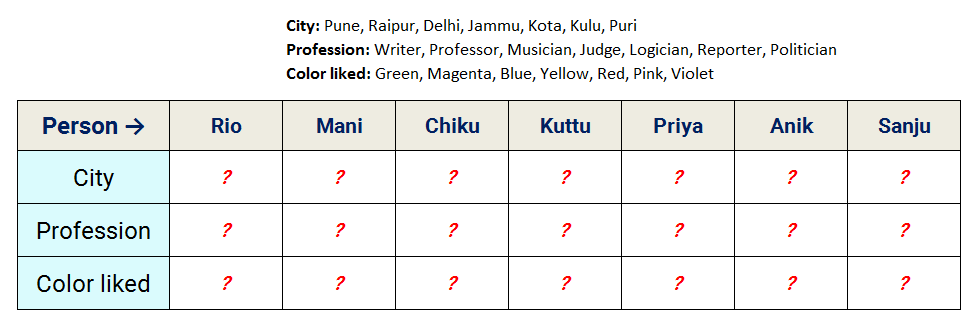
The assignment table with seven person names as columns and three properties: City, Profession and Color liked as row labels are used for keeping track of property value assignments and helping further Clue analysis.
Assignment table at the start.
Solution to the 7 Person Three Properties Reasoning Puzzle: Clue Analysis and Assignments
Stage 1: Direct Assignments (including negative assignments)
Clue 1. "Chiku, a Judge, is from Kota."
- Results: Chiku gets Profession "Judge" and City "Kota".
Clue 8. "Anik is a Logician."
- Result: Anik gets Profession "Logician".
Clue 12. "Mani is a Musician."
- Result: Mani gets Profession "Musician".
Negative assignments:
Clue 11. "Sanju from Jammu does not like Pink."
- Result: Sanju gets Color liking "not Pink".
Clue 3. "Rio is not from Kulu."
- Result: Rio get City "not Kulu".
Stage 1 assignments:
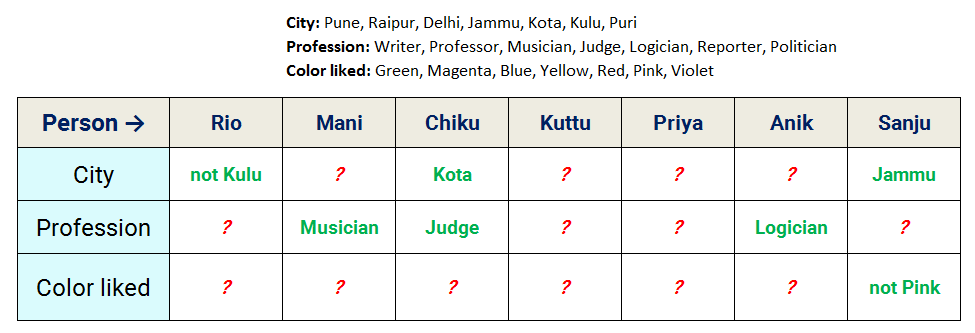
Direct assignment first strategy ensures anchoring the grid of Person-Properties with specific values for continuing Clue analysis and assignments.
Stage 2: Constraints by Two-Position Block
Clue 2. "Priya and Anik like Green and Magenta, though not necessarily in that order."
- Results: This is a Two-position Block (a valuable pattern) of Color liking of either "Green or Magenta" for either of "Priya or Anik".
- Implications are three-fold:
- Priya and Anik cannot like any Color other than Green or Magenta.
- The Colors Green and Magenta cannot be liked by any other person.
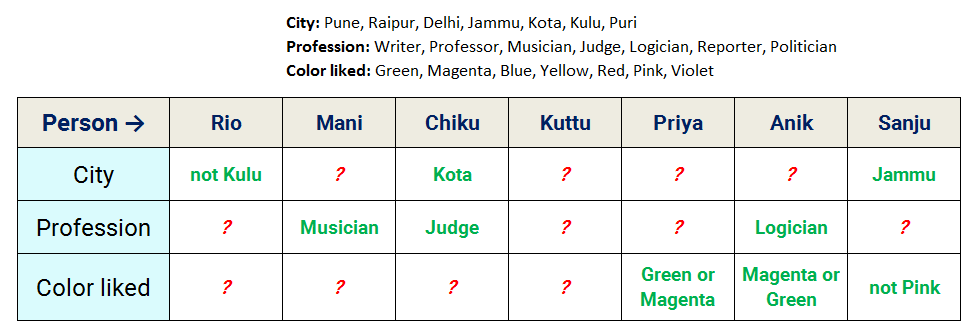
- Effectively, Color liking for these two positions are assigned with the only uncertainty of which of the two would finally like which of the two colors.
Stage 2 assignments:
Stage 3: Elimination of Positions by Conflicts: Vertical Bonds
Clue 4. "The person from Kulu is a Writer and likes Blue."
- Results:
- Forms a three-valued Vertical-Bond for one Person.
- Kuttu is the only Person with none of the three values assigned yet.
- Rio is out of consideration as he is not from Kulu (Clue 3) and Priya is not the free person because of Color liking conflict.
- Kuttu gets: Kulu, Writer and Blue.
The last assignment by the three-valued vertical bond won't have been possible without the two-position block on the two colors Green and Magenta.
The two-position block has proved its value.
Clue 6. "The Politician from Puri likes Magenta."
- Results: Vertical Bond (three-valued): "Puri-Politician-Magenta". Only Priya is eligible as the other probable candidate Anik has a different profession "Logician".
- Assignments: "Puri, Politician, Magenta" to Priya and "Green" to Anik by default.
Stage 3 assignments:
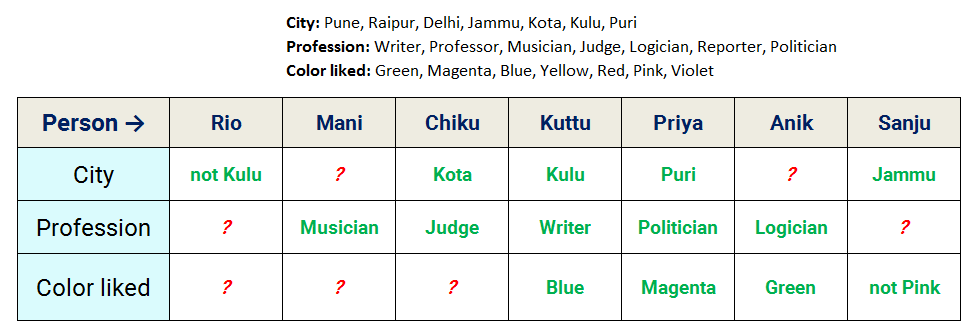
Stage 4: Logic Analysis by an Interlocked Group of Clues with Shared Constraints
Usually, this is the last stage of Clue analysis purely by logic analysis of Clues and positions of a well-filled assignment table. Often, groups of Clues sharing same values of a property point out the way forward. This is the last strategy often heavily dependent on logic analysis.
Clue 9. "The person from Raipur is a Professor."
- Results: Vertical Bond (two-valued): "Raipur-Professor."
- Assignment: Rio gets City "Raipur" and Profession "Professor". Sanju gets Profession "Reporter" by default as the only Profession still not assigned for the Person Sanju still to be assigned a Profession.
Clue 7. "The Professor and the Musician like Violet and Red, though not necessarily in that order."
- Results: Vertical Bond (two-position two-valued): "Professor or Musician" liking Colors "Violet or Red".
- This two-position Block of "Violet or Red" Color liking is for "Rio or Mani".
Clue 10. "The person from Delhi likes Red."
- Results: Vertical Bond (two-valued): "Delhi-Red". The two-position "Violet or Red" block for "Rio or Mani" broken.
- Assignments: Mani gets City "Delhi", Color liking "Red" and Rio gets Color liking "Violet."
- Additional assignment: Anik get City "Pune" by default as the only person left for the only City left to be assigned.
Clue 5. "The Reporter likes Yellow."
- Implication: Vertical Bond (two-valued): "Reporter-Yellow".
- Assignments: Sanju gets Color liking "Yellow" and Chiku gets Color liking "Pink" not liked by Sanju.
The completed assignments:
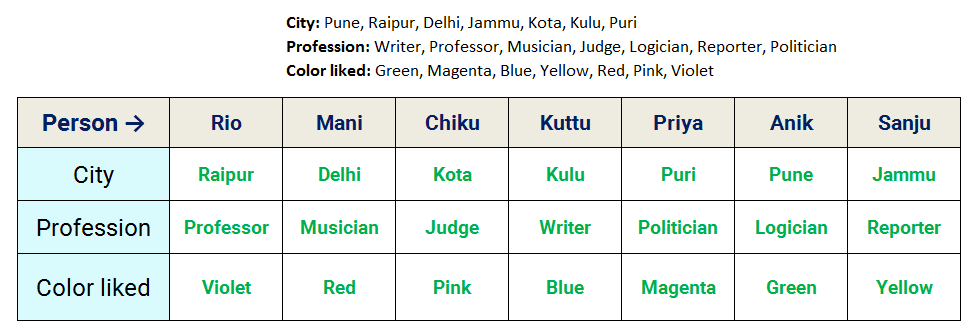
Answers to the questions
Question 1. Who likes color Blue?
- Kuttu
- Anik
- Chiku
- Sanju
- Rio
Answer 1. Option 1: Kuttu.
Question 2. What is the place of the Logician?
- Delhi
- Kota
- Puri
- Jammu
- Pune
Answer 2. Option 5: Pune.
Question 3. What is the color that the person from Raipur likes?
- Red
- Violet
- Magenta
- Pink
- Green
Answer 3. Option 2: Violet.
Question 4. What is the color that Anik likes?
- Red
- Magenta
- Yellow
- Green
- Pink
Answer 4. Option 4: Green.
Question 5. Which of the following combinations is correct?
- Puri-Red
- Chiku-Kulu
- Judge-Pink
- Delhi-Reporter
- Rio-Musician
Answer 5. Option 3: Judge-Pink.
Summary of Clue Analysis Roadmap: Deduction by Strategies
Phase 1: Anchor the Grid (Direct Assignments)
- Clue 1 → Chiku = Judge (Profession) + Kota (City)
- Clue 8 → Anik = Logician
- Clue 11 → Sanju = Jammu (City) + not-Pink
- Clue 12 → Mani = Musician
- Clue 3 → Rio = not-Kulu
Phase 2: Constraint Propagation (Two-Position Block)
- Clue 2 → Priya/Anik = Green/Magenta
- ├─ Blocks the positions and others from these colors
Phase 3: Elimination (Vertical Bonds)
- Clue 4 → Kulu = Writer + Blue
- ├─ Only Kuttu fits (Rio not-Kulu by Clue 3, Anik/Logician not Writer) → Kuttu = Kulu/Writer/Blue
- Clue 6 → Politician from Puri likes Magenta → Priya = Magenta (Anik = Green); Priya = Politician
Phase 4: Interlocking Logic: Clues 9, 7 and 10
- Clue 9 → Raipur = Professor → Rio = Professor
- Clue 7 + 10 → Professor/Musician = Violet/Red + Delhi = Red → Mani = Delhi/Red, Rio = Violet
- Clue 5 → Reporter = Yellow → Sanju = Reporter/Yellow
- Default → Anik = Pune (last remaining city)
The strategies used produced a quick and clean solution to this puzzle. The more effective ones:
- Direct assignments first: Produced fairly large number of assignments quickly.
- Two-position Block: With no more direct assignments available, the next best course of action was to create a two-position block by two color likings (Green or Magenta).
- Three-valued vertical bond: The formation of the two-position block enabled (it occupied two Color liking positions reducing the probables drastically) direct assignments of three property values to a single eligible person Kuttu by elimination of other possibilities.
- Groups of Clues Interlocked in Logic Analysis: Clues 9, 7 and 10 together took care of most remaining assignments.
The puzzle is taken from an SBO PO recruitment exam for selecting quick and young minds.
More puzzles to enjoy
From our large collection of interesting puzzles enjoy: Maze puzzles, Riddles, Inventive puzzles, Reasoning puzzles, Paradoxes, Mathematical puzzles, Logic puzzles, Number lock puzzles, Missing number puzzles, River crossing puzzles, Ball weighing puzzles, and Matchstick puzzles.
You may also look at the full collection of puzzles at one place in the Challenging brain teasers with solutions: Long list.
Enjoy puzzle solving while learning problem solving techniques.